

Copy dataflow between sites and exports with Import Dataflow and Copy Dataflow
Learn to copy your dataflow between sites and exports using the features Import Dataflow and Copy Dataflow in Productsup.
If you need to create multiple sites with the same data structure, you can set up a dataflow in one site and copy it into other sites. This way, you don't need to set up your dataflow manually in each site.
To copy a dataflow, you can use two features in Productsup that serve slightly different use cases:
- Import Dataflow lets you copy the dataflow of the entire site. This option overwrites all exports, segments, connections, and rule boxes of the target site with the exports, segments, connections, and rule boxes of your source site.
- When you copy the dataflow of the entire site using Import Dataflow, you delete all previous versions of the target dataflow.
- The platform copies connections between all stages and exports present in the source dataflow. If the import stage of the target dataflow doesn't have an attribute used in a connection in the source dataflow, the platform adds the missing attribute and marks the related connection in red, making it a warning connection.
- The platform doesn't copy rule box conditions from the source dataflow.
- If your source dataflow has list-based rule boxes, the platform copies the rule boxes and their setups excluding the lists chosen in the rule boxes. You need to finalize list-related configuration manually.
Tip
Alternatively, you can share the relevant lists across the entire organization or project, in which case the platform copies the list selection in the rule boxes.
- The platform copies both active and inactive exports from the site of the source dataflow but doesn't copy the destinations of these exports. You need to add and set them up manually.
- If the target dataflow doesn't have a needed attribute at the intermediate or export stage, the platform creates a new user-generated attribute. This applies to both connected and unconnected attributes in the source dataflow.
- If your source dataflow has a CSA export, the platform copies only the export itself, the connections, and the rule boxes that exist between the intermediate stage and this export. The platform doesn't copy the mapping lists, the rule boxes that apply those lists, the Classifications dropdown in Dataflow, or the options available in the dropdown. You need to add and set up the mapping list and the appropriate rule box in the target site, and then run the site to get the Classifications dropdown and all needed category-specific attributes in the target dataflow.
If you have CSA exports in your dataflow, we recommend using Copy Dataflow instead of Import Dataflow to avoid losing previous dataflow versions and the ability to revert changes.
- Copy Dataflow lets you copy the dataflow of a selected export. This option overwrites all connections and rule boxes between the intermediate stage and the target export with the connections and rule boxes of your source export.
- When you copy an export dataflow using Copy Dataflow, the platform automatically saves the previous dataflow of the target export as a version called Dataflow Backup, which lets you revert changes if necessary.
- The platform copies rule box conditions, but we recommend checking if the rule box condition has its original setup after copying the dataflow.
- If your source export dataflow has list-based rule boxes, the platform copies the rule boxes and their setups excluding the lists chosen in the rule boxes. You need to finalize list-related configuration manually.
Tip
Alternatively, you can share the relevant lists across the entire organization or project, in which case the platform copies the list selection in the rule boxes.
- If the target export dataflow doesn't have an attribute that is present and has a connection in the source export dataflow, the platform creates a new user-generated attribute. This doesn't apply to a CSA export.
- To see how the platform copies dataflows for CSA exports, see Copy the dataflow of a CSA export using Copy Dataflow.
If neither Import Dataflow nor Copy Dataflow is fit for your needs, you can alternatively consider the following features:
- Duplicate an export (you can duplicate exports only within the same site).
Prerequisites
To copy the entire dataflow with the Import Dataflow feature, make sure that:
- The source and target sites have the same attribute names in the import stage. You can also use Import Dataflow without the needed attributes in the import stage of the target site, but it creates warning connections, which means you need to import the missing attributes into the target site later on.
To copy a dataflow of a regular export with the Copy Dataflow feature, you need to have a target export added in the needed site.
To copy a dataflow of a CSA export with the Copy Dataflow feature, make sure that:
- The target site has the needed CSA export.
- The source and target exports have the same attribute names in the export stage. For CSA exports, Copy Dataflow only copies connections between attributes that are exact matches.
Copy a dataflow of the whole site using Import Dataflow
When copying a dataflow using Import Dataflow, the platform overwrites the existing dataflow, all its versions, the enabled exports, and the segments of the target site with those of the source site.
Go to Settings from your target site's main menu.
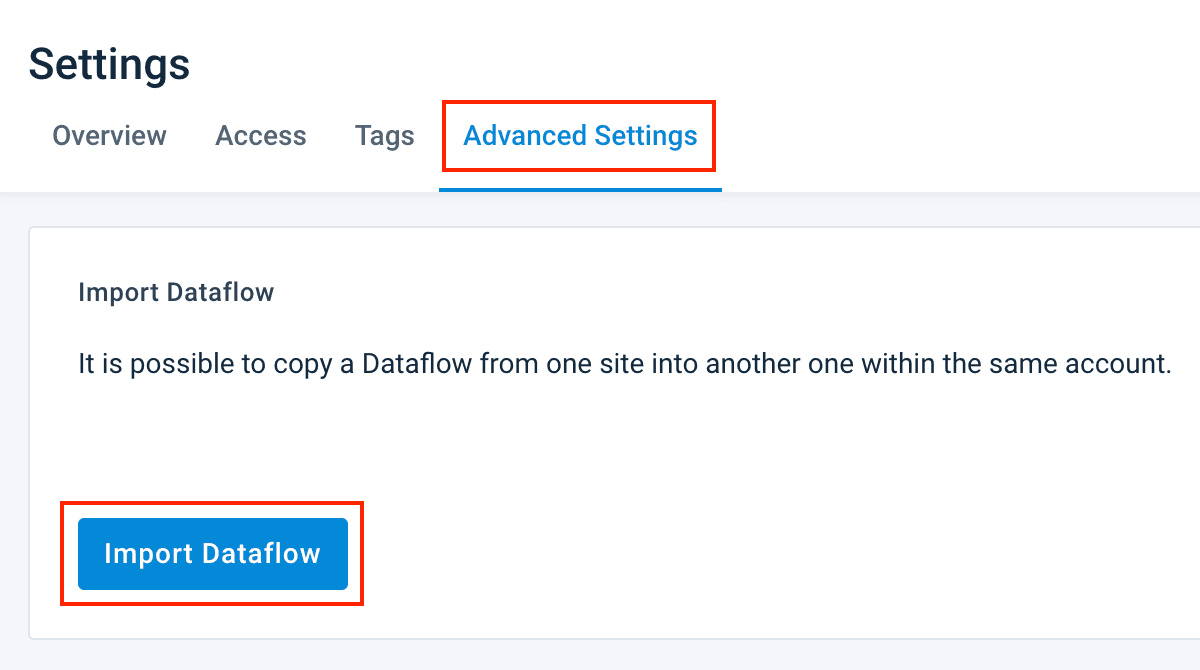
Select the Advanced Settings tab.
Select Import Dataflow.
Select a source site where you want to copy a dataflow from.
Select Continue.
Choose Import to overwrite the dataflow of the target site.
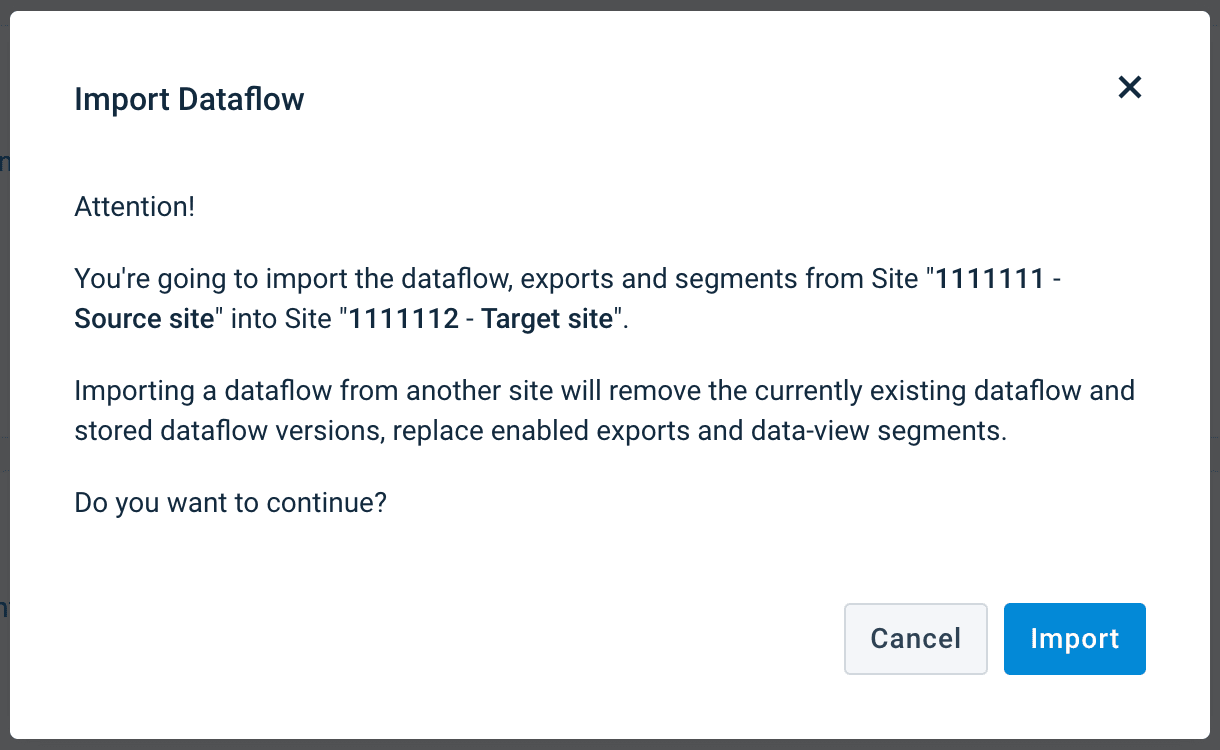
Your imported dataflow may have red warning connections if the import-stage attribute names are different in the source and target sites. You need to import the missing attributes into the target site.
Copy the dataflow of a regular export using Copy Dataflow
Copy Dataflow lets you copy a dataflow of a regular export to another export located in the same or different site without overwriting the dataflow of the entire target site. The platform replaces the mapping between the intermediate stage and the target export with the mapping of the source export and its intermediate stage. It also creates all missing attributes in the intermediate and export stages in the target site if a connected attribute is present in the source export dataflow but is missing in the target export dataflow. See the beginning of this document for details on what gets copied into the target export.
When copying an export dataflow using Copy Dataflow, the platform automatically saves the previous dataflow of the target export as a version, which lets you revert changes if necessary.
Go to Dataflow from your target site’s main menu.
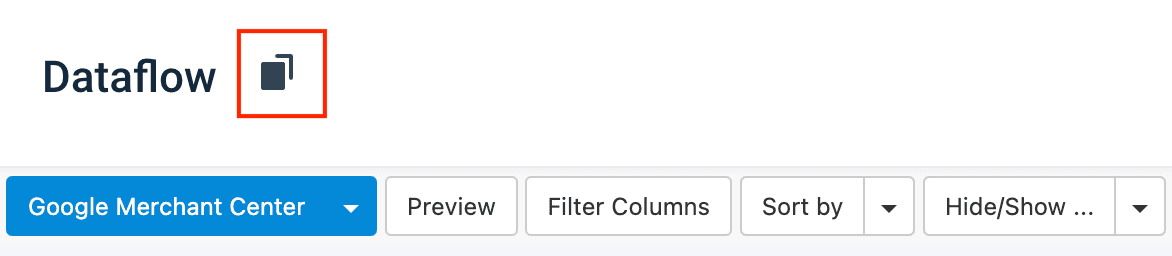
Select the copy icon next to the page title.
In the Source export section, select the necessary source site and export in the Site and Export dropdowns.
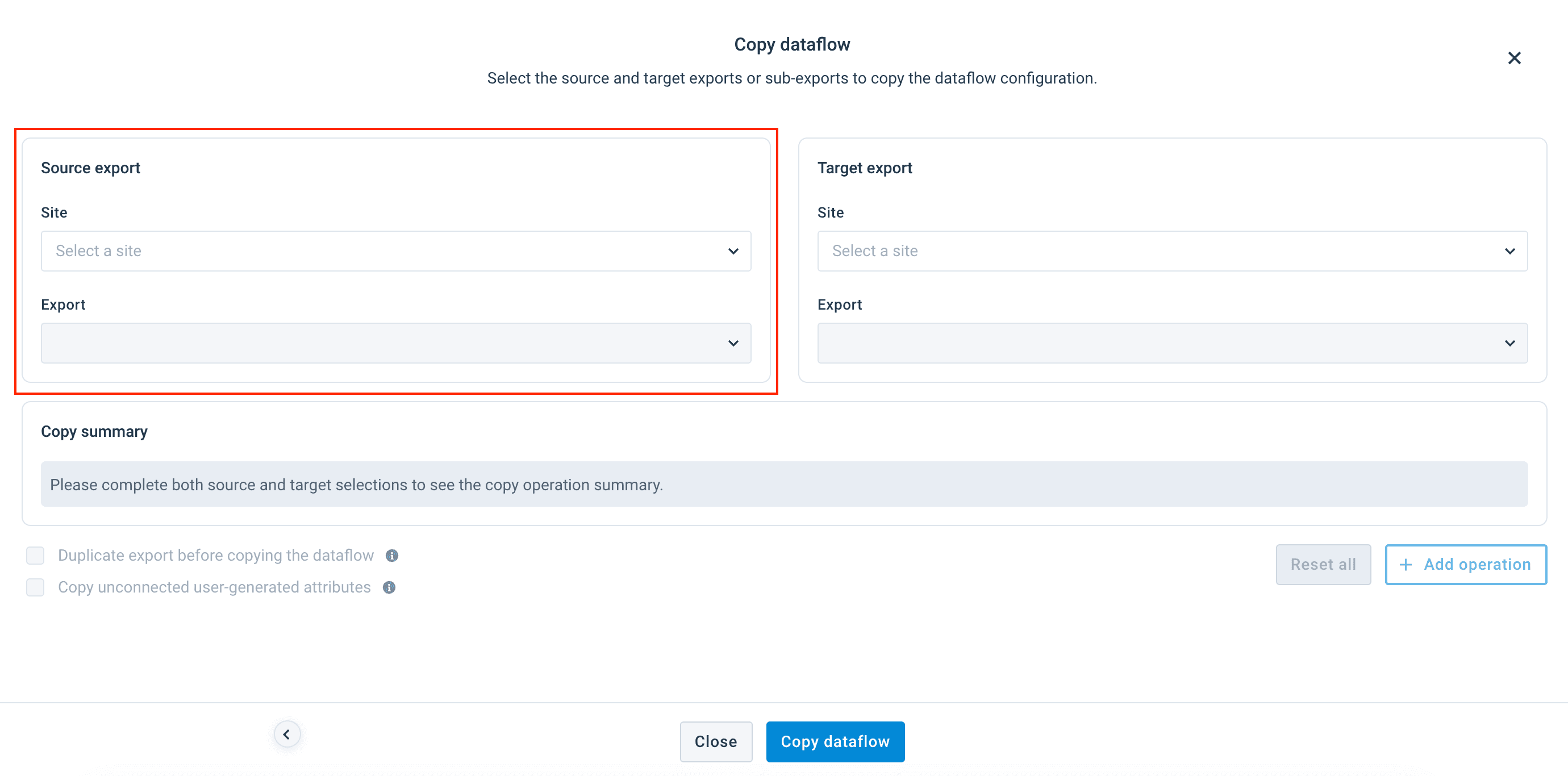
In the Target export section, select the necessary target site and export in the Site and Export dropdowns.
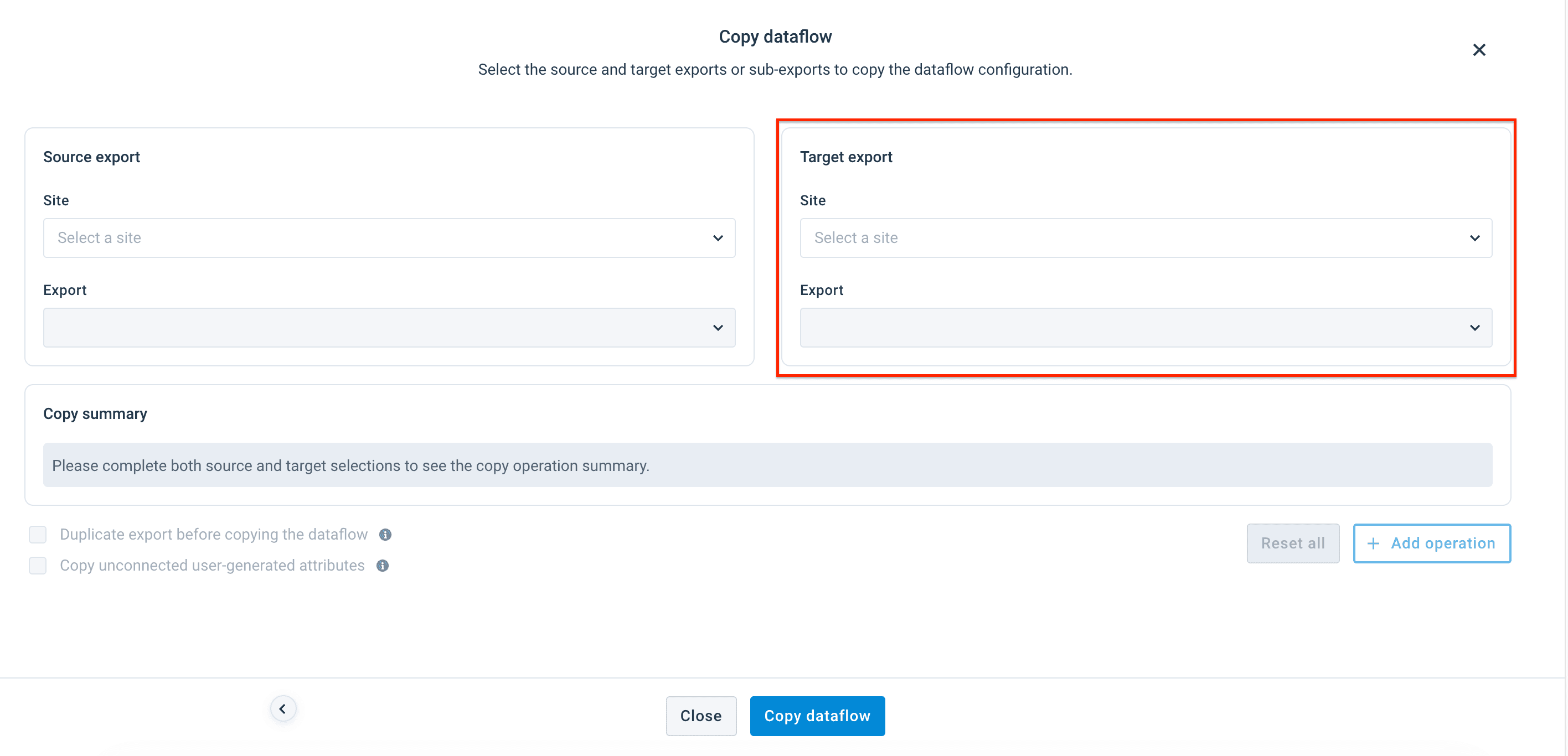
Check the Copy summary section to see if the platform validates the operation.

If you want to copy only one dataflow, skip this step and proceed with see the relevant section.If you want to copy multiple dataflows from different sources into different targets, you can create multiple source-target pairs:
- Select Add operation to add the source-target pair you have already selected.
- Select another source-target pair in the Source export and Target export sections. Then, select Add operation. Repeat this for each desired source-target pair.
Each source-target pair appears in the Ready to copy section. You can select the
 icon to delete a pair.
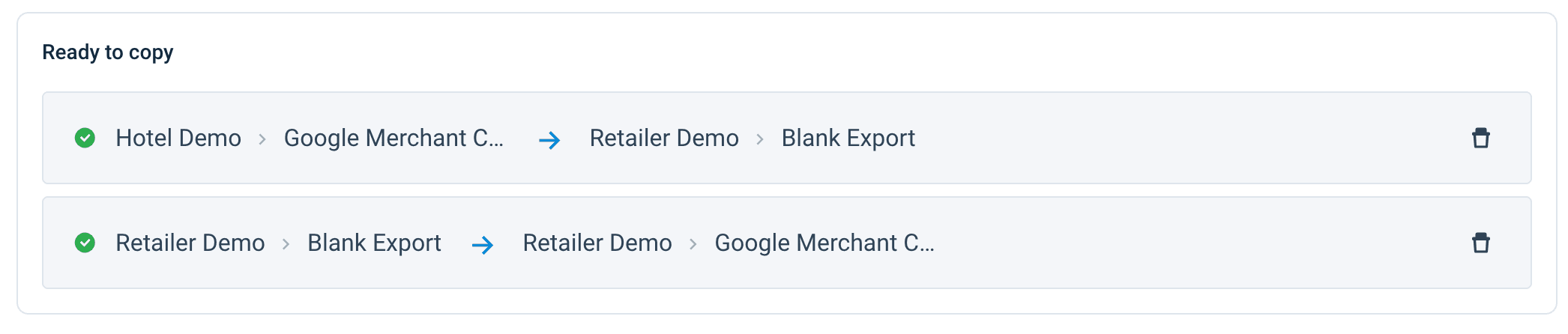
In Duplicate export before copying the dataflow, decide if you want to overwrite an existing target export or create a duplicate:
- If checked, the platform creates an identical copy of your target export and copies the source export dataflow to it without overwriting the dataflow of the existing target export.
- If unchecked, the platform overwrites the dataflow of the existing target export with the source export dataflow. If needed, you can later revert changes by loading an automatically saved version of the previous dataflow.
In Copy unconnected user-generated attributes, decide if you want to copy unconnected user-generated attributes from the source export to the target export:
- If checked, the target export additionally gets the unconnected user-generated attributes of the source export and its intermediate stage.
- If unchecked, the target export doesn't get the unconnected user-generated attributes of the source export and its intermediate stage.
Select Copy dataflow.
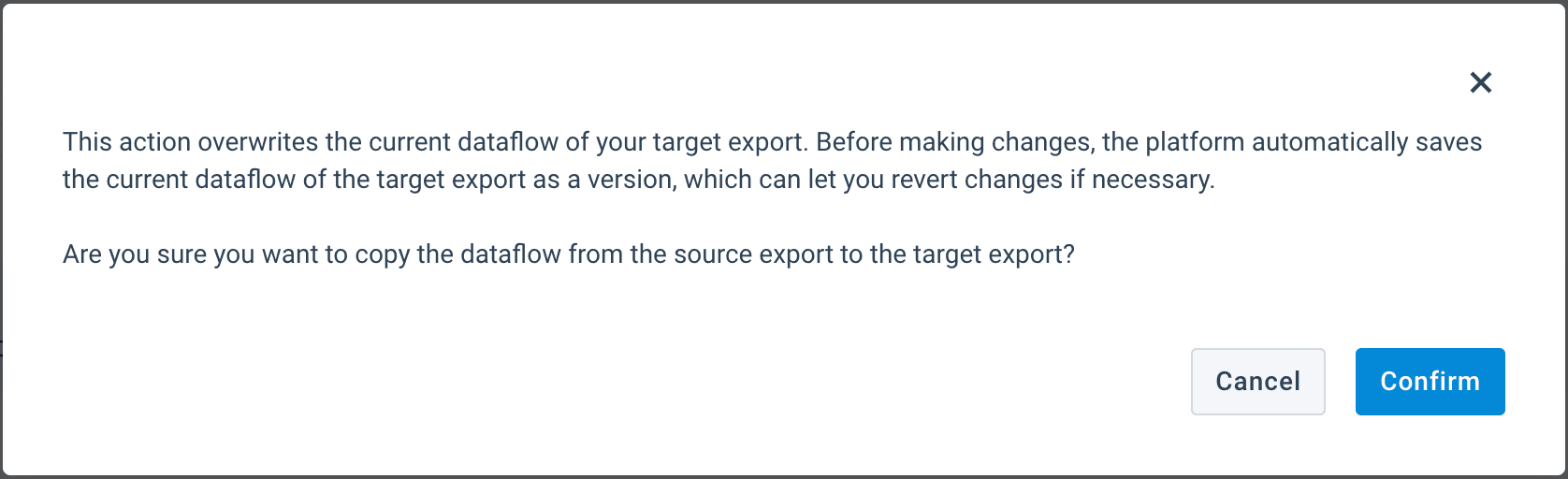
Select Confirm in the warning pop-up to proceed with copying the dataflow.
Copy the dataflow of a CSA export using Copy Dataflow
Copy Dataflow lets you copy a dataflow of a CSA export to another CSA export located in the same or different site without overwriting the dataflow of the entire target site. You can copy dataflows between CSA exports or between their sub-exports. You can't copy a CSA export's dataflow to a sub-export or vice versa.
Important
In this context, the term sub-export refers to the classifications, categories, product types, or other options available for CSA exports in the Classifications dropdown in Dataflow and Data View. Choosing a sub-export (one of the options in this dropdown), you can work with attributes relevant for specific classifications, categories, product types, etc.
When copying a dataflow of a CSA export or its sub-export, the platform first checks the names of the connected export-stage attributes in the source dataflow. If the target dataflow has an export-stage attribute with the same name, the platform overwrites the connections and rule boxes of this attribute in the target dataflow with the connections and rule boxes of the same attribute in your source CSA export or sub-export. Here are the details on what gets copied from the source to the target dataflow for CSA exports and sub-exports:
| Part of dataflow | What is copied to the target export dataflow | What isn't copied to the target export dataflow |
|---|---|---|
| CSA export | - Connections and rule boxes of the attributes in the source CSA export. The same attribute names must be present in both source and target export. - Rule box conditions. | - User-generated attributes, their connections, and rule boxes. - Any connections and rule boxes of the attributes that are present in the source CSA export but don't exist in the target CSA export. - The Classifications dropdown in Dataflow and the sub-exports available in it. - The connections, rule boxes, and rule box conditions of the attributes available in the sub-exports of the source CSA export. - Mapping rule boxes, such as Classification Mapping or Taxonomy Mapping, and the lists they use. - Lists selected in other list-based rule boxes. The rule boxes themselves are copied, but the list selection isn't. Lists themselves aren't copied as well. - Some settings of rule box conditions may not be copied. You should check them manually. You need to add and set up the mapping list and the appropriate rule box in the target site, and then run the site to get the Classifications dropdown and all needed sub-exports in the target dataflow. |
| Sub-export | - Connections and rule boxes of the attributes in the source sub-export. The same attribute names must be present in both source and target sub-export. - Rule box conditions. The Classifications dropdown in Dataflow must already be available in the target dataflow prior to copying. | - User-generated attributes, their connections, and rule boxes. - Any connections and rule boxes of the attributes that are present in the source sub-export but don't exist in the target sub-export. - The connections, rule boxes, and rule box conditions of the CSA export that the source sub-export belongs to. - Lists selected in list-based rule boxes. The rule boxes themselves are copied, but the list selection isn't. Lists themselves aren't copied as well. - Some settings of rule box conditions may not be copied. You should check them manually. |
When copying an export dataflow, the platform automatically saves the previous dataflow of the target export as a version, which lets you revert changes if necessary.
Go to Dataflow from your site’s main menu.
Select the copy icon next to the page title.
In the Source export section, select the necessary source site and export in the Site and Export dropdowns. If you are copying a dataflow of a sub-export, choose the needed source sub-export in Sub-export. If you are copying a CSA export's dataflow, leave it empty.
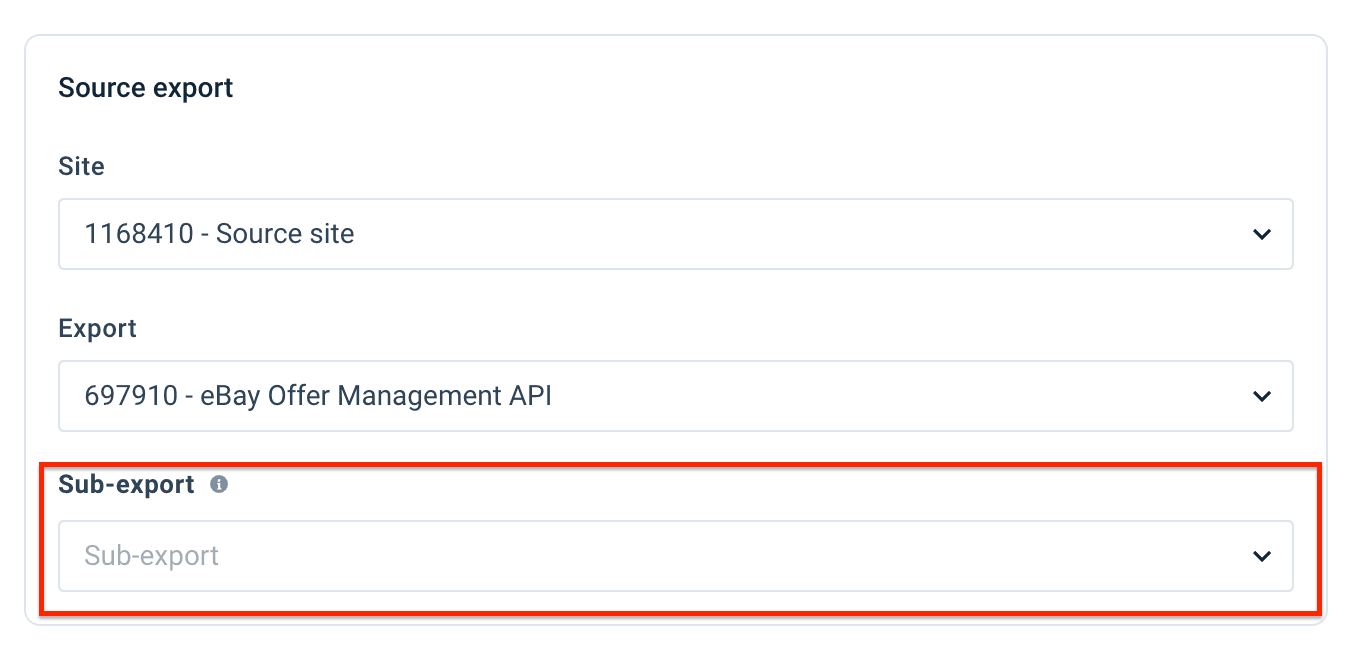
In the Target export section, select the necessary target site and export in the Site and Export dropdowns. If you are copying a dataflow of a sub-export, choose the needed target sub-export in Sub-export. If you are copying a CSA export's dataflow, leave it empty.
If you want to copy only one dataflow, skip this step and proceed with see the relevant section.If you want to copy multiple dataflows from different sources into different targets, you can create multiple source-target pairs:
- Select Add operation to add the source-target pair you have already selected.
- Select another source-target pair in the Source export and Target export sections. Then, select Add operation to add it. Repeat this for each desired source-target pair.
Each source-target pair appears in the Ready to copy Target exports section. You can select the
icon to delete a pair.
This step is only relevant when copying a CSA export. If you are copying a sub-export, leave the box Duplicate export before copying the dataflow unchecked and proceed with see the relevant section.To overwrite the existing target CSA export or create a duplicate for it, use the checkbox Duplicate export before copying the dataflow:
- If checked, the platform creates an identical copy of your target CSA export and copies the source dataflow to it without overwriting the dataflow of the existing target CSA export.
- If unchecked, the platform overwrites the dataflow of the existing target CSA export with the source dataflow. If needed, you can later revert changes by loading an automatically saved version of the previous dataflow.
Leave the box Copy unconnected user-generated attributes unchecked. User-generated attributes aren't copied for CSA exports and sub-exports in any case.
Select Copy dataflow.
Select Confirm in the warning pop-up to proceed with copying the dataflow.
How is this guide?